The architectural industry has witnessed a dramatic transformation in how projects are presented and communicated to clients, stakeholders, and planning authorities. Moving beyond traditional static renderings and floor plans, architectural animation has emerged as a powerful tool that brings unbuilt structures to life through dynamic, immersive visual experiences. This technology allows viewers to understand spatial relationships, materiality, and the experiential qualities of a design in ways that static images simply cannot convey. For practices working on complex residential extensions, commercial developments, and innovative architectural solutions, animation has become an essential component of the design presentation toolkit.
Understanding the Fundamentals of Architectural Animation
Architectural animation represents the convergence of design expertise and cutting-edge digital technology. At its core, this technique involves creating sequential frames that, when played in succession, simulate movement through or around a proposed building or space. The evolution from hand-drawn plans to modern animation techniques has fundamentally altered how architects communicate their vision.
The Technical Framework
The creation process begins with precise three-dimensional modelling based on architectural drawings and specifications. Every element must be accurately represented:
- Geometric accuracy: Walls, floors, ceilings, and structural elements
- Material properties: Textures, reflectivity, and surface characteristics
- Lighting conditions: Natural daylight simulation and artificial lighting systems
- Environmental context: Surrounding buildings, landscaping, and urban fabric
- Temporal variations: Changing light throughout the day or across seasons
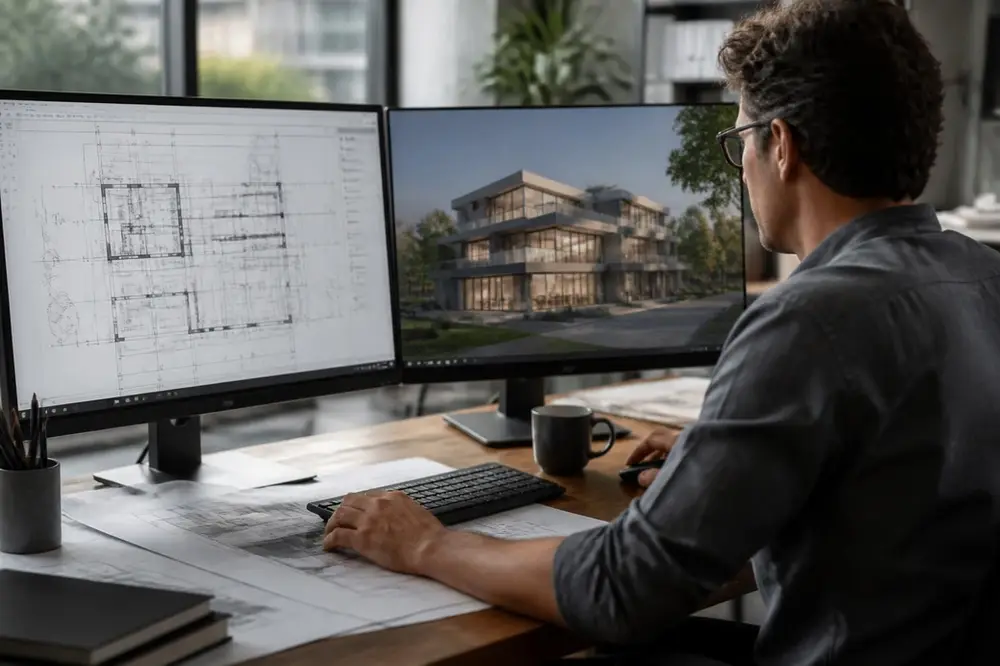
Professional-grade software enables architects to build comprehensive digital models that serve as the foundation for animation sequences. These platforms integrate realistic physics simulations, ensuring that shadows fall correctly, materials respond authentically to light, and spatial proportions remain accurate throughout the animated sequence.
Movement and Perspective Strategies
Camera movement within architectural animation follows carefully choreographed paths designed to showcase the most compelling aspects of a design. Unlike static imagery, animation allows viewers to experience a building as they would in reality-moving through spaces, observing transitions between rooms, and understanding circulation patterns.
Effective animations employ various camera techniques. Walkthroughs simulate the human experience of navigating a space, whilst flyovers provide contextual understanding of how a building sits within its surroundings. Close-up sequences highlight detailed craftsmanship and material selections, particularly valuable when presenting luxury residential properties or commercial fit-outs.
Applications Across Project Types
The versatility of architectural animation extends across numerous project scales and typologies. From intimate domestic extensions to large-scale commercial developments, this technology adapts to meet varied communication requirements. Commercial office leasing and museum fundraising represent just two sectors where animation has proven particularly effective.
Residential Development Presentations
For residential projects, animation excels at conveying lifestyle rather than merely showing spaces. A single-storey extension comes alive when viewers can follow natural light patterns throughout the day, observe how the new space integrates with existing architecture, and understand sight lines from various vantage points.
Key residential animation elements include:
- 1Morning-to-evening lighting transitions
- 2Furniture placement demonstrating space functionality
- 3Garden integration and outdoor living areas
- 4Material warmth and tactile qualities
- 5Family interaction scenarios within spaces
These animations prove invaluable during planning applications, helping neighbours and planning officers visualize exactly how proposed developments will appear and function. The ability to demonstrate that a new build dwelling respects the character of surrounding properties whilst delivering contemporary living standards can significantly strengthen approval prospects.
Commercial and Mixed-Use Developments
Commercial projects benefit enormously from animation's capacity to demonstrate functionality and spatial efficiency. Potential tenants can virtually experience office layouts, retail environments, or hospitality spaces before construction commences, making leasing decisions more confident and reducing vacancy periods.
The ability to showcase different configuration options within the same space proves particularly valuable. An animation can demonstrate how an open-plan office transforms for various tenancy scenarios, or how a retail unit adapts across different brand requirements.
Technical Considerations and Production Quality
Achieving photorealistic results requires meticulous attention to technical parameters throughout the production process. Creating photorealistic animations demands powerful computing resources and expertise in multiple software platforms, from 3D modelling through to post-production refinement.
Rendering Efficiency and Quality Balance
Rendering represents the most computationally intensive phase of animation production. Each frame requires complex calculations to simulate light behaviour, material interactions, and atmospheric effects. A 60-second animation at 30 frames per second requires rendering 1,800 individual frames, each potentially taking minutes or hours depending on quality settings.
Optimisation strategies include:
- Progressive rendering: Building image quality iteratively
- Render farm distribution: Spreading computational load across multiple machines
- Strategic quality allocation: Higher detail where viewers focus attention
- Efficient geometry management: Simplifying unseen or distant elements
Many practices find that balancing production time against output quality requires strategic decisions about where to invest rendering resources. Close-up sequences of key architectural features merit maximum quality settings, whilst distant contextual elements can utilize more efficient rendering approaches.
Software Ecosystem and Workflow Integration
The tools and software used in architectural animation have evolved dramatically, offering increasingly sophisticated capabilities whilst becoming more accessible. Industry-standard platforms now integrate seamlessly with architectural CAD software, allowing models developed during the design process to transition smoothly into animation production.
Modern workflows typically involve multiple specialized applications. Three-dimensional modelling software establishes geometric accuracy, whilst dedicated rendering engines handle lighting and material calculations. Compositing applications then refine the output, adding atmospheric effects, color grading, and motion graphics elements that enhance storytelling.
Strategic Implementation for Architectural Practices
Incorporating animation into practice workflows requires thoughtful planning and resource allocation. The investment-both financial and in terms of staff training-must align with business objectives and client expectations. For established practices like Shorplans Developments, integrating animation capabilities enhances service offerings whilst differentiating the practice in competitive market conditions.
Client Communication and Expectation Management
Animations transform client relationships by eliminating ambiguity about design intent. Clients lacking architectural literacy can immediately grasp spatial concepts that would require considerable explanation through traditional drawings. This clarity reduces revision cycles and builds confidence in design decisions.
However, managing expectations remains crucial. Photorealistic animations can appear so convincing that clients may forget they're viewing unbuilt proposals. Clear communication about material availability, cost implications, and planning constraints ensures that animation serves as a design communication tool rather than creating unrealistic expectations.
Planning Authority Engagement
Local planning authorities increasingly value animation submissions alongside traditional documentation. The ability to demonstrate contextual integration, overlooking impacts, and design quality through moving images addresses common planning concerns more effectively than static elevations or visualizations.
When presenting complex extension schemes within conservation areas or sensitive contexts, animations showing the development from neighbouring vantage points, street-level approaches, and key public viewpoints provide planners with comprehensive understanding. This thoroughness can accelerate approval processes and reduce objections based on misunderstanding.
Future Developments and Emerging Technologies
The trajectory of architectural animation points toward increasingly immersive and interactive experiences. Modern animation techniques continue evolving, incorporating real-time rendering capabilities that allow instantaneous design modifications within animated environments.
Real-Time Visualization and Virtual Reality
Game engine technology has migrated into architectural visualization, enabling real-time animations where clients can control their viewing experience. Rather than following predetermined camera paths, users navigate freely through spaces, examining details at their own pace and from perspectives that interest them most.
Emerging capabilities include:
- Live design modification during client presentations
- Multi-user virtual reality walkthroughs for remote collaboration
- Integration with building information modelling for construction coordination
- Artificial intelligence-enhanced rendering for faster production
- Augmented reality on-site visualization of proposed developments
These technologies democratize access to sophisticated visualization tools whilst reducing production timelines. What once required weeks of rendering can now occur in real-time, fundamentally changing how practices present work and engage clients in design development.
Sustainability Visualization and Performance Metrics
Beyond aesthetic presentation, future animations will increasingly incorporate environmental performance data. Visualizing solar gain patterns, natural ventilation strategies, or thermal performance creates powerful narratives about sustainable design choices. Clients can literally see how passive design strategies reduce energy consumption whilst enhancing comfort.
This capability aligns perfectly with growing demand for environmentally responsible architecture. Demonstrating that modern house designs achieve ambitious sustainability targets through intelligent design rather than merely technological additions strengthens project value propositions.
Industry Standards and Best Practices
Professional architectural animation adheres to rigorous standards ensuring accuracy, clarity, and ethical representation. The comprehensive overview of architectural animation standards emphasizes the importance of truthful representation and transparent communication about design status.
Accuracy and Professional Responsibility
Animations must faithfully represent approved or proposed designs without embellishment that could mislead clients or authorities. Material finishes, spatial proportions, and contextual integration should reflect achievable outcomes rather than idealized scenarios. This ethical foundation maintains professional credibility whilst protecting practices from disputes arising from misrepresentation.
Documentation accompanying animations should clearly identify design status-whether conceptual exploration, planning submission, or construction documentation. This clarity manages expectations whilst allowing animation to serve appropriate purposes at each project stage.
Collaboration Between Disciplines
Successful animation production requires coordination across multiple specialists. Architects provide design intent and geometric accuracy, whilst visualization specialists contribute technical expertise in lighting, materials, and cinematography. When projects involve structural and architectural services, ensuring that animations accurately represent structural solutions alongside aesthetic qualities becomes essential.
This collaborative framework ensures that animations serve their intended purpose whilst maintaining the highest professional standards throughout production.
Cost-Benefit Analysis for Practice Integration
Investing in animation capabilities requires careful financial consideration. Equipment, software licensing, staff training, and production time represent significant costs that must deliver proportional value through enhanced service offerings, improved client satisfaction, and competitive differentiation.
Return on Investment Metrics
Practices typically evaluate animation investment through multiple lenses. Project win rates often improve when proposals include compelling visual communication. Client satisfaction scores rise when design intent is clearly understood before construction. Marketing effectiveness increases with engaging portfolio content that demonstrates capability and creativity.
For practices handling diverse project portfolios spanning residential extensions, commercial developments, and new builds, animation capabilities serve multiple project types, spreading investment costs across varied revenue streams.
Production Timeline Considerations
Understanding production timelines helps practices price services appropriately and manage client expectations. Simple walkthroughs of modest residential extensions might require several days, whilst complex mixed-use developments with multiple animation sequences could demand weeks of production effort.
Typical timeline phases:
- 1Briefing and concept development (1-2 days)
- 2Model preparation and refinement (2-4 days)
- 3Material and lighting setup (1-3 days)
- 4Animation path definition (1-2 days)
- 5Rendering and processing (3-7 days)
- 6Post-production and refinement (2-3 days)
These durations vary substantially based on project complexity, quality requirements, and available computing resources. Practices must balance production efficiency against output quality, ensuring that animation adds genuine value rather than becoming an expensive burden that erodes project profitability.
Architectural animation has evolved from a luxury presentation tool into an essential communication medium that bridges the gap between design intent and client understanding. By transforming static concepts into dynamic, immersive experiences, animation enables architects to present their vision with unprecedented clarity and impact. Whether you're planning a residential extension, commercial development, or new build project, Shorplans Developments combines over 20 years of architectural expertise with innovative presentation techniques to bring your vision to life and guide it through every stage from concept to completion.
Article written using RankPill.
Thinking about starting a project?
Speak to our RIBA Chartered team today and book a free, no-obligation quotation.
Get A Free Quote