London's property market demands more than just a lick of paint. High-yield HMOs (Houses in Multiple Occupation) require a delicate balance of architectural ingenuity and strict regulatory compliance. Successful landlords know that "squeezing in" rooms is a recipe for licensing failure. Instead, the focus must shift toward intelligent spatial design and premium finishes that justify top-tier rents.
This article delves into how professional architectural and structural planning transforms standard properties into high-performing assets. Whether it is navigating the labyrinth of council regulations or creating communal spaces that actually feel like home, precision is non-negotiable. Let's explore the five essential steps to mastering the London HMO market.
What is an HMO and How Does It Work?
Understanding the fundamentals is the first step toward a profitable investment. An HMO is a property rented out by at least three people who are not from one "household" but share facilities like the bathroom and kitchen. For larger operations, mandatory licensing applies once you hit five or more tenants.
How does an HMO work in practice? It functions as a high-density residential model where the landlord manages individual tenancies within a single building. While the management intensity is higher than a standard buy-to-let, the rental yield is significantly more robust. The key is ensuring the property is legally fit for purpose through expert architectural services.
1. Smart Layouts: Maximizing Room Count Without Sacrificing Quality
Maximizing a floor plan is an art form. In the London market, every square inch represents potential revenue, but cutting corners leads to "un-lettable" spaces. A skilled HMO architect understands that flow and functionality are as important as the number of doors.
Smart layouts utilize often-overlooked areas like wide hallways or awkward alcoves. By reconfiguring internal partitions, you can often find space for an extra en-suite or a dedicated study nook. However, quality must remain the priority. A room that feels like a prison cell will only attract high turnover and low-quality tenants. Precision in the planning stage ensures you meet the sweet spot between density and desirability.
2. Compliance is Key: Navigating Fire Safety and Room Sizes
Compliance can confuse even the most seasoned developer. London boroughs often impose standards that exceed national minimums. While the national minimum for a single room is 6.51 m², many London councils — such as Westminster or Camden — frequently demand 7.5 m² or more.
Fire safety is the second pillar of compliance. An HMO requires a sophisticated network of interlinked fire alarms, heat detectors in kitchens, and FD30-rated fire doors. These aren't just suggestions; they are legal requirements for licensing. Working with experienced HMO architects ensures your architectural drawings account for protected escape routes and emergency lighting from day one. Failing a licensing inspection because a door swings the wrong way is an expensive mistake you want to avoid.
3. Professional Finishes: Why Luxury Bathrooms Attract High-Yield Tenants
The "standard" student-digs aesthetic is dead in the high-yield professional HMO market. Today's tenants are looking for lifestyle upgrades. Professional finishes in high-traffic areas like kitchens and bathrooms are the quickest way to differentiate your property.
Take, for instance, a recent project in Kingston. By installing high-spec, contemporary bathrooms with premium tiling and integrated storage, the landlord was able to command a 20% premium over the local average. High-quality materials also tend to be more durable, reducing long-term maintenance costs. When a bathroom looks like it belongs in a boutique hotel, tenants stay longer and treat the space with more respect.
4. Open-Plan Living: Using Structural Engineering to Create Space
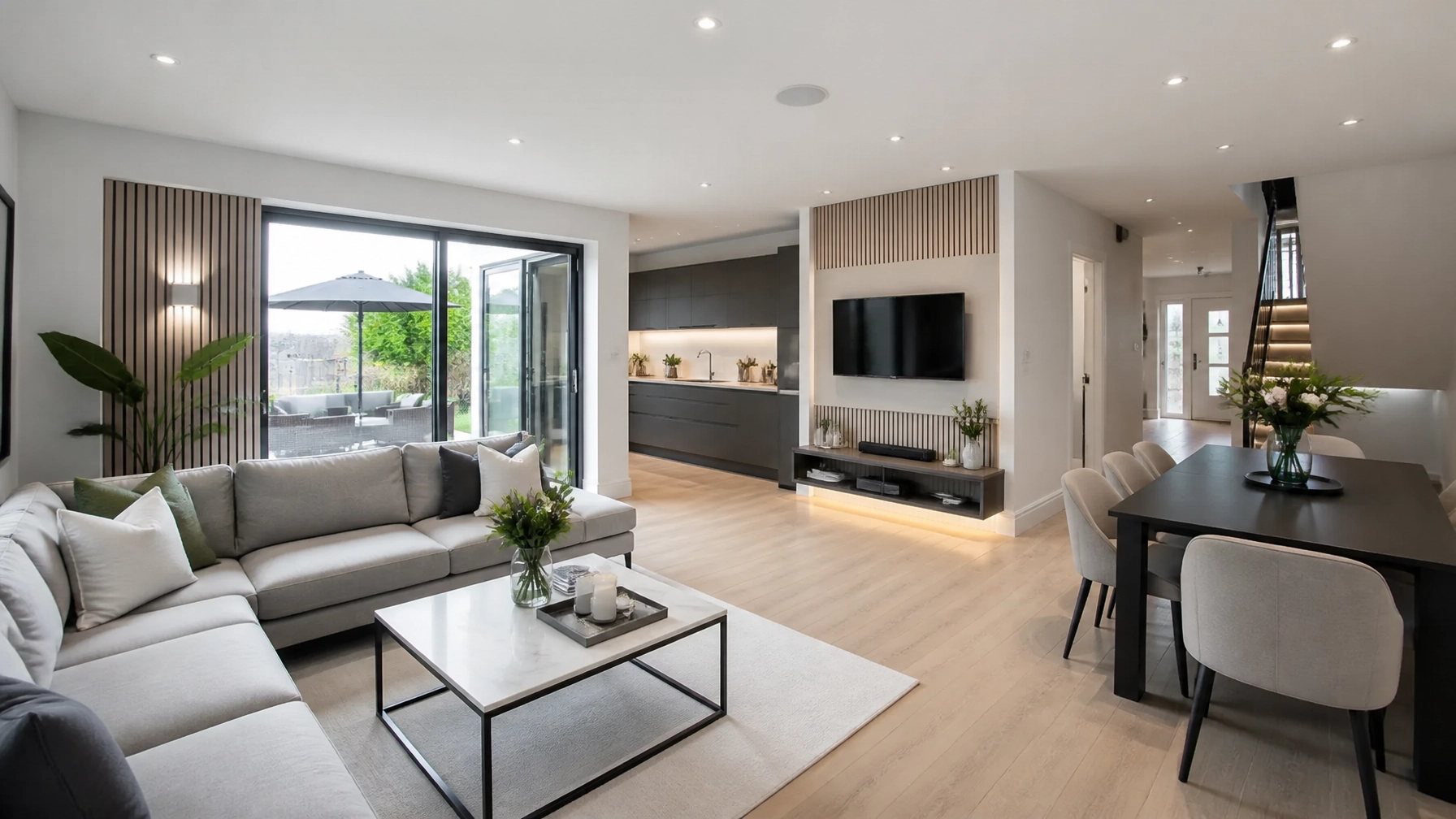
Communal spaces are the heart of a successful HMO. If the shared living area is cramped or dark, the property will feel like a collection of isolated bedsits rather than a home. Creating an open-plan environment often requires removing internal load-bearing walls to let light and air circulate.
This is where structural engineering services become vital. To safely open up a ground floor, you need precise structural calculations for RSJ steel beams. Our team at Shorplans ensures that these structural changes are not just safe but optimized for the architectural vision. Using floor-to-ceiling glass doors or strategic extensions can turn a dark Victorian terrace into a bright, modern living hub that tenants will fight over.
5. In-House Coordination: Speeding Up the HMO Process
The biggest enemy of any HMO development is time. Coordinating between an architect and a separate structural engineer often leads to communication gaps, delays, and conflicting plans. This fragmented approach can add weeks — or months — to your project timeline.
Shorplans Developments solves this by offering in-house coordination. We handle both the architectural design and the structural calculations under one roof. This integrated workflow means that when an architect proposes a daring layout change, the structural engineer is already in the room to validate it. This synergy speeds up the planning application process and ensures that the transition to the construction phase is seamless.
Final Thoughts
The London HMO market is an intricate system of regulations and design trends. Success depends on your ability to deliver a product that exceeds both council requirements and tenant expectations. By focusing on smart layouts, absolute compliance, and premium finishes, you secure your yield for years to come.
Ready to transform your property into a high-yield HMO? Contact Shorplans Developments today to discuss how our integrated architectural and structural expertise can streamline your next project.
Thinking about starting a project?
Speak to our RIBA Chartered team today and book a free, no-obligation quotation.
Get A Free Quote