This companion to the Shorplans landlord licensing portal explains how to investigate a rental property's licensing position. Licensing is address- and occupation-specific: a borough name alone is not enough to determine the answer.
The council directory below covers all 32 London boroughs and the City of London. It links to official guidance rather than publishing an assumed live register of scheme coverage. Check the current designation, map, dates and exemptions for your exact property.
01
Three schemes to distinguish
Mandatory HMO licensing generally covers HMOs occupied by five or more people forming more than one household and sharing relevant facilities, subject to the statutory definition and exemptions. Do not rely on an old three-storey threshold.
Additional licensing can bring other HMOs within licensing in an area designated by the council. Selective licensing can cover other privately rented homes within a designated area, subject to exemptions. An ordinary single-household tenancy can therefore require a licence in the right area.
02
Check the property borough by borough
Use the council's address checker or scheme map, not just the postcode district or the fact that an agent calls the property an HMO. Review mandatory, additional and selective licensing separately, including commencement and expiry dates.
The official council links in this guide are starting points, not a declaration that each council currently runs all three schemes. Where a link covers one scheme, navigate to that council's other private-renting licensing guidance as well.
For every borough record: the exact address, number of people and households, shared facilities, relevant scheme and designation dates, exemptions, current fee, application evidence and licence conditions. A neighbouring borough's result cannot be copied across.
03
What an application commonly needs
Prepare an accurate floor plan with room dimensions and uses, management and ownership details, occupancy information and the safety documentation requested by that council. Fire precautions and amenity provision must be assessed for the actual property.
Council room and amenity standards can exceed national minimum licence conditions. Do not advertise occupancy based only on a room-area calculation; the licence and the wider standards matter.
04
Planning and licensing are separate
A housing licence does not establish planning permission for HMO use, a flat conversion or a change of use. Article 4 restrictions and planning history need their own review.
Buying a licensed property does not automatically transfer the licence or authorise an increased occupancy. Confirm the correct application route and whether a new owner, manager or arrangement requires further action.
05
Keep compliance current
Track application and renewal dates, evidence of submission, the licence decision and ongoing conditions. Do not assume every licence lasts the same period or that payment alone authorises all proposed letting arrangements.
The existing Shorplans landlord portal is linked alongside the official sources for service information. Any eligibility review still needs the exact address and intended occupation, followed by confirmation of current council requirements.
Checklist
Points to confirm before you commit time or money.
- Record people, households, tenure and shared facilities.
- Check the official scheme maps and dates for the exact address.
- Verify exemptions, fees, local standards and application evidence.
- Check planning separately and retain a renewal and conditions tracker.
From our projects
Real Shorplans work, and why it is relevant here.
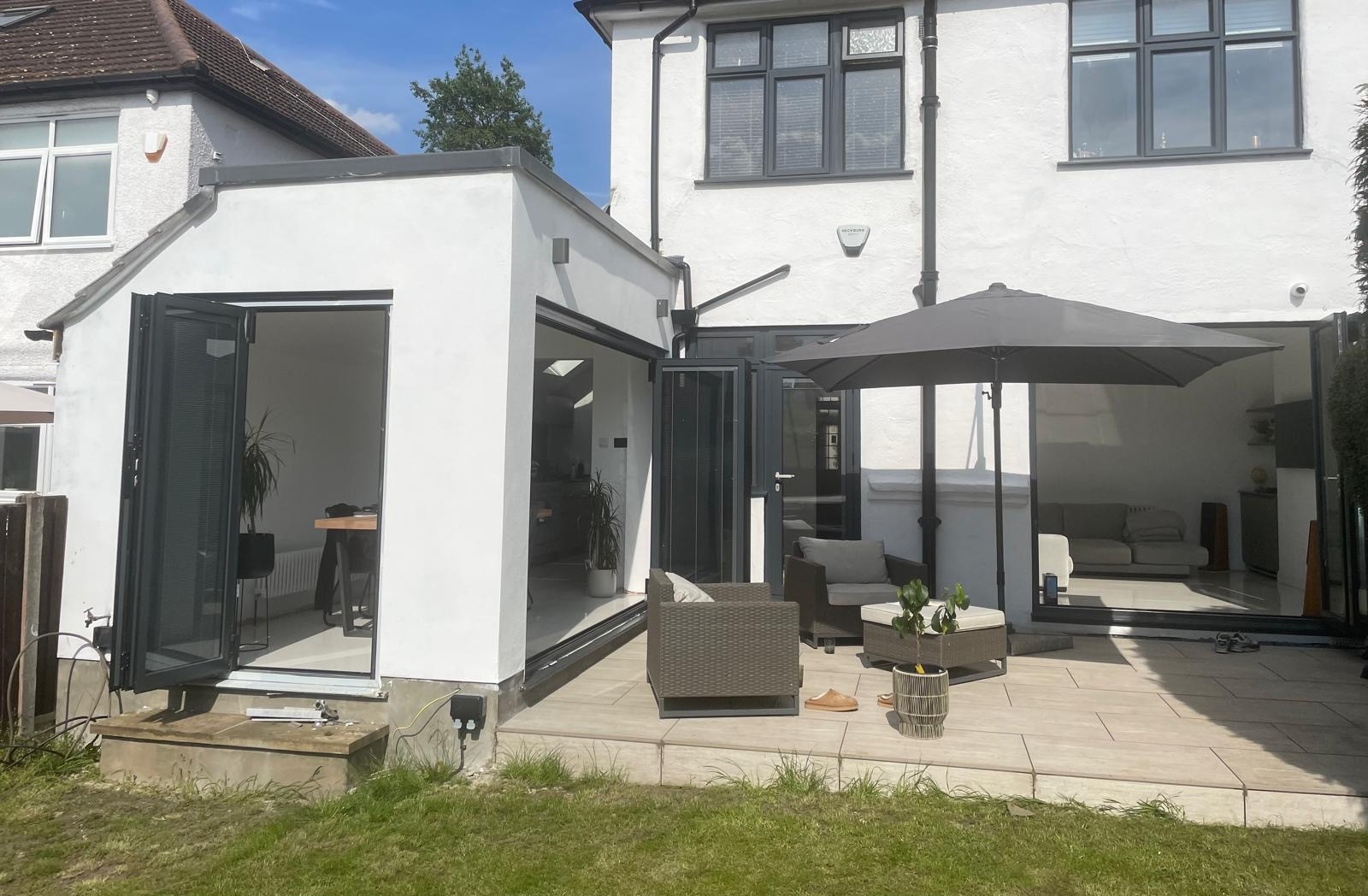
Carshalton, Surrey
Single story side extension scheme
Why it is relevant: The Purley five-apartment conversion is a relevant example of investment-led residential layout coordination. It is not described as an HMO and is not evidence that a particular licence is required or held.
Single story side extension scheme to create a new dining area into an open plane kitchen , generous glazing for natural light, and efficient use of space for modern living.
View related projectsOfficial sources
- 1.GOV.UK — HMO licensing (opens in a new tab)
- 2.GOV.UK — selective licensing in the private rented sector (opens in a new tab)
- 3.Shorplans — Landlord Licensing & HMO Portal (opens in a new tab)
- 4.Barking and Dagenham — council property licensing guidance (opens in a new tab)
- 5.Barnet — council property licensing guidance (opens in a new tab)
- 6.Bexley — council property licensing guidance (opens in a new tab)
- 7.Brent — council property licensing guidance (opens in a new tab)
- 8.Bromley — council property licensing guidance (opens in a new tab)
- 9.Camden — council property licensing guidance (opens in a new tab)
- 10.City of London — council property licensing guidance (opens in a new tab)
- 11.Croydon — council property licensing guidance (opens in a new tab)
- 12.Ealing — council property licensing guidance (opens in a new tab)
- 13.Enfield — council property licensing guidance (opens in a new tab)
- 14.Greenwich — council property licensing guidance (opens in a new tab)
- 15.Hackney — council property licensing guidance (opens in a new tab)
- 16.Hammersmith and Fulham — council property licensing guidance (opens in a new tab)
- 17.Haringey — council property licensing guidance (opens in a new tab)
- 18.Harrow — council property licensing guidance (opens in a new tab)
- 19.Havering — council property licensing guidance (opens in a new tab)
- 20.Hillingdon — council property licensing guidance (opens in a new tab)
- 21.Hounslow — council property licensing guidance (opens in a new tab)
- 22.Islington — council property licensing guidance (opens in a new tab)
- 23.Kensington and Chelsea — council property licensing guidance (opens in a new tab)
- 24.Kingston upon Thames — council property licensing guidance (opens in a new tab)
- 25.Lambeth — council property licensing guidance (opens in a new tab)
- 26.Lewisham — council property licensing guidance (opens in a new tab)
- 27.Merton — council property licensing guidance (opens in a new tab)
- 28.Newham — council property licensing guidance (opens in a new tab)
- 29.Redbridge — council property licensing guidance (opens in a new tab)
- 30.Richmond upon Thames — council property licensing guidance (opens in a new tab)
- 31.Southwark — council property licensing guidance (opens in a new tab)
- 32.Sutton — council property licensing guidance (opens in a new tab)
- 33.Tower Hamlets — council property licensing guidance (opens in a new tab)
- 34.Waltham Forest — council property licensing guidance (opens in a new tab)
- 35.Wandsworth — council property licensing guidance (opens in a new tab)
- 36.Westminster — council property licensing guidance (opens in a new tab)
General guidance for England, with a London focus. Requirements depend on the property, proposal and current rules. This is not a site-specific design, legal opinion, fixed quotation or guarantee of approval. Check the linked official guidance and obtain project-specific professional advice before acting. Last reviewed .
Applying this to your property?
Tell us about the building and what you want to achieve. We will reply with how we would approach it and a fee proposal.